
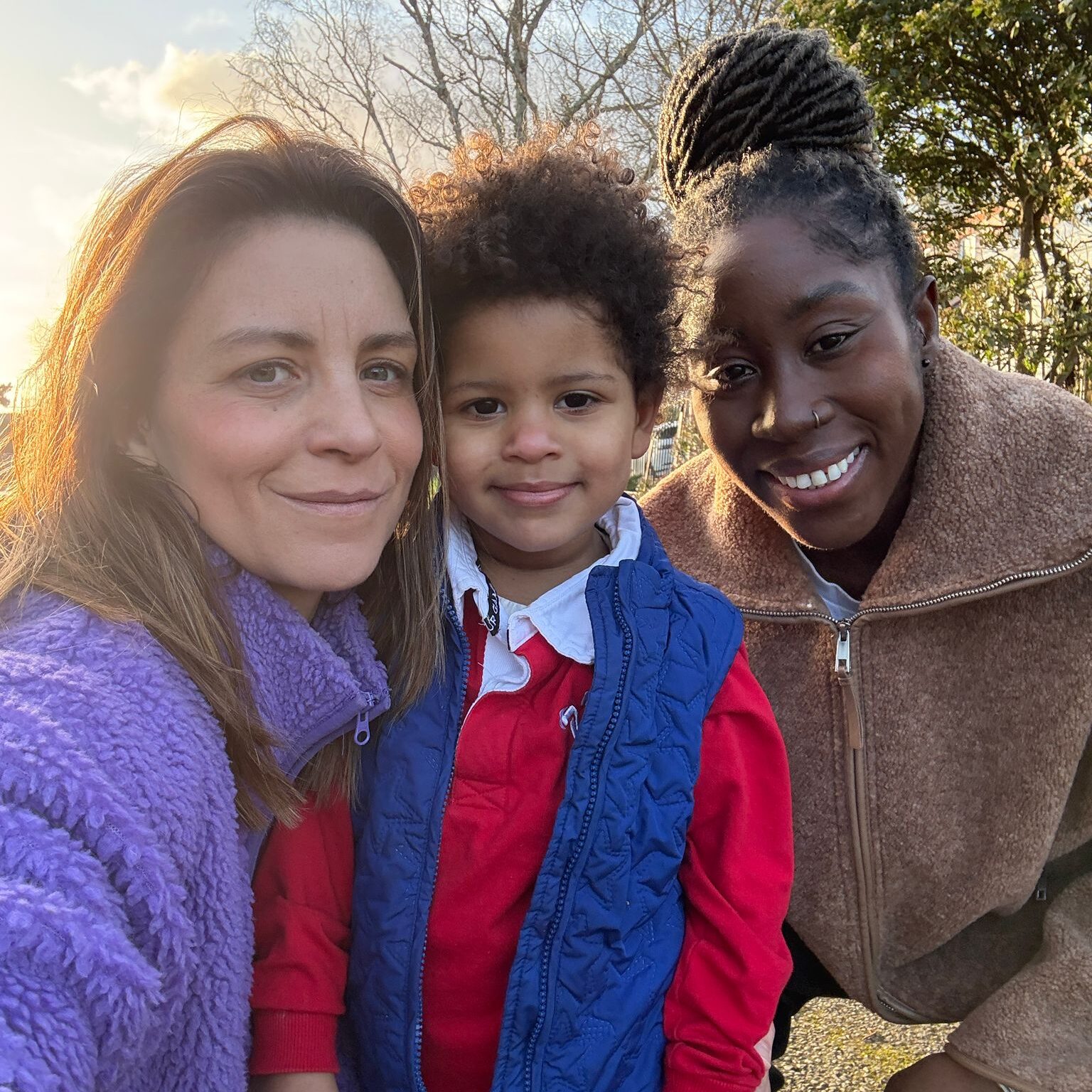
With 71 England caps, an Olympic Games, a historic Arsenal quadruple and a career that spanned four countries and nearly two decades, Anita Asante is one of the most decorated players in English women’s football history. But right now, the thing she’s most focused on is a toddler called Gigi and a left foot challenge.
Anita and her wife, sports broadcaster and former Welsh hockey international Beth Fisher, welcomed their daughter Gigi in June 2023 – a process in which Anita’s embryo was carried by Beth. A method increasingly chosen by same-sex couples, and one that Anita speaks about with both tenderness and transparency.
Now working across broadcasting, coaching and punditry, Anita is still very much in the women’s football ecosystem – just from a different vantage point. And this Mother’s Day, she’ll be at Ashton Gate in Bristol for the Subway Women’s League Cup final between Chelsea and Manchester United, introducing Gigi to her very first live football match.
Become a Nonchalant VIP for ad free browsing.
For Mother’s Day, we sat down with Anita to talk about shared motherhood, the IVF journey she and Beth navigated together, what it means to raise a queer family inside the WSL’s growing embrace, and why she’s already working on Gigi’s left foot.
Mother’s Day means something different to everyone. What does it mean to you, and how are you celebrating this year?
Mother’s Day is just a special day for us to spend time together as a family unit. The way we celebrate is just by being together, doing activities with Gigi and making her feel like she can do anything in the world – giving her as much exposure to as many experiences as possible. That’s why it’s going to be so special to take her to her very first football match. She’s at an age now where she can probably take it in a bit more, too.
You and Beth knew early on that you wanted to start a family. What was it like holding that dream alongside a demanding playing career?
We did know quite early on, because we’re both one of three siblings. So it was just like, of course we want to have a kid – it’s fun to have a child and share life experiences with them. During my playing career, I didn’t think it was a possibility. So being able to have this now, at a time where I know who I am, I feel more confident and more assured in my place in the world – I feel like I’m a better parent because of it. I’ve probably made enough mistakes growing up already that I can share some of that knowledge with Gigi.
Article continues below.




Ultimately, nothing can prepare you for parenthood. You just roll with it, and it’s super fun. I know everyone talks about the challenges of work-life balance, but you just make it work. You make it work because you love your kids and you love your family unit. And kids are quite adaptable – time to them is never-ending. They don’t know if you’ve been gone a day or ten days, especially when they’re smaller. So far, that’s actually been fine for us.
You’ve described that first night home from hospital after Gigi was born as very overwhelming. When did you actually feel like a mum for the first time?
I think it’s important to be real about that, because you can never really be prepared for parenthood. It was overwhelming in the sense that I’d been this kind of selfish, obsessed athlete, where I’m told where to be, what to do on a consistent basis – and now I’m responsible for another human being. Making sure she’s fed, dressed, bathed… that was like, wow. I’ve only ever had to take care of myself.
But it was overwhelming in the way that your heart is just so full. You can’t believe you can have this much love for another being. To the point that you’re checking their breathing every five seconds, even though you know they’re fine.
I felt like a mum the minute I walked in the door with her in the baby carrier. I was like, this is a piece of us. This is our child, our responsibility now. It’s such a special moment and a special feeling.
You’ve talked about the WSL being an environment where you felt supported as a same-sex couple and as a new mother. How much did that sense of belonging shape this chapter of your life?
People always say, when you’ve been a player that’s played in the WSL – or even prior to it – you’ve been fortunate enough to watch the growth and the positive shifts that come with that. There’s been a real shift in the way we talk about inclusivity, in the way we see all different types of families, in the way we talk about women’s sport more generally as something every woman should be able to partake in or support.
For me, that’s a wonderful thing to have witnessed – that transformation over time. And to feel that any person can hopefully go to a game, an event, and be their authentic selves and find community within that space. It really opens up the feeling that football is for everybody, across age and demographics. We are full of all types of people throughout society, and the game should be no different.
The WSL has grown enormously – record attendances, landmark broadcast deals, and expansion to 14 teams. As someone who’s played in the league and now works in the game from a different side, what does that growth mean to you?
It makes me extremely proud, because it makes me feel like everything I’ve done – individually and collectively with my peers over the years – has been worth it. To see the opportunities and access that come with that growth is providing actual, tangible career paths for youngsters. They can see the vision now in a way I couldn’t when I was younger. They can go, “I want to get to the top, and I can start that now,” as opposed to waiting later in their career. That’s massive.
The visibility too – lots of people can now watch women’s football on their TV screens. They know what grounds teams play at. They can get to those grounds. It’s across print media. We’re interesting, multi-faceted people within women’s football, and we share lots of commonalities with wider society. It’s super powerful, impactful and inspirational.
People used to say to me, are you disappointed that you didn’t grow up in this era? And I’m like, well no – because sometimes you don’t always get to live in the house that you would have built, but you build it for the next generation. And that’s the same when you’re building the next generation of your family. You want to put them in a better position than you were in.
That’s a beautiful analogy. There’s this cultural moment happening in the WSL – it’s become a space where LGBTQ+ fans feel genuinely safe and seen. Did you feel that shift during your playing days?
I saw that shift in my latter playing days, especially. I was always surrounded by proud athletes from the LGBTQ+ community in my dressing room – they were who they were. We had fun together, we shared stories and experiences. But now you’ve got top-level WSL players using their platforms to actually tell their stories and impact the next generation, so that they feel confident in their everyday lives – whether they’re at school or in the workplace – that they can just be who they are.
They’re seeing their role models do that to a massive audience. That stuff is so far-reaching, and it has this monopoly effect – it touches one person, that person touches another. It’s fantastic to see the league embracing these personalities, the issues they stand for, and who they represent.
Football shaped your identity for over two decades. Now, motherhood is part of that too. How do you hold all of those parts of yourself – the Lioness, the player, the coach, the pundit, the mum?
How do I hold it all together? I don’t know if I do. I don’t know if anyone does. I probably go through waves where I do it better than others. But I’ve been able to reshape my identity. Football has been so much a part of how I view myself, how others have viewed me – this is who I am, this is what I do. And now I’ve been able to grow a new identity and recognise that I don’t have to be one thing or the other. I can be all of these things.
I look at it from an entrepreneurial lens. Entrepreneurs are out there doing the things they’re passionate about, and I’m passionate about a lot of different things. Many of them are associated with football, but now I have the avenues and pathways to explore them in a way I didn’t before. That’s given me a greater sense of who I am and what I can do. You can step into new careers all the time – you just have to jump. You just have to put yourself there to experience it.
What do you want Gigi to know about what it took to bring her into the world?
I’d want Gigi to know that so many people, including myself and Beth, have fought to have families and fought to have the right to bring a baby into the world. To give them the opportunity to have all the parts of what makes us human – the joy, the sadness, the excitement, the friendships. That’s what makes us the species that we are. We get to experience the highs and lows, and we get to chase things that give us that adrenaline rush.
I want Gigi to have all of that. But I want her to come at it from another level. Women are having so much more opportunity and access to things they should have always had. We’ve already fought for rights that she can now enjoy. So I want her to embrace all of that, follow her own passions, try to impact whatever she’s doing in the best way she can, and hopefully impact every single person she connects with in a positive way.
And of course, hopefully she plays for England – because I’m already on the left foot challenge with her. That’s my goal. We need more left-footers in the game. Beth’s going to keep fighting me, saying she’s got to represent Wales, but she’s got no hope. It’s fine.
For queer couples who are at the beginning of the IVF journey and maybe feeling overwhelmed – what would you tell them?
We were really fortunate that we already had people in our network who had gone on the journey or were embarking on it. We had people we could speak to – where do they go, who do they speak to, what questions should they ask? But I think it’s important to get as much information as you can, to feel comfortable in the direction you’re going in. If you have a network of people you can speak to, do that. Speak to professionals – your GP, any healthcare providers you have contact with.
And speak to your family. Family are hugely important, because you’re bringing a child into your unit, but they’re coming into the bigger picture of both families too. Share what the expectations are, because it’s a long journey, it’s an expensive journey, it’s an emotional journey. Lots of things can happen along the way that you’re not prepared for. But if you know what you should be prepared for, it helps it go that bit smoother.
Navigating fertility treatment as a same-sex couple comes with questions that straight couples probably don’t face – choosing a donor, deciding who carries. What was the most unexpected part of the process for you and Beth?
We opted for shared motherhood, so Beth carried my embryo. We were very fortunate that the healthcare providers were amazing – we felt really supported. But really, it’s the emotional side of the journey. You’re taking hormone injections, and it can impact your hormones. You might feel more emotional than you normally do, or less emotional. And you can both be experiencing the journey at the same time but having completely different feelings.
Making sure you’re constantly checking in with each other and communicating well is so important. Just sharing how you’re feeling, because it is quite taxing on the body. You have to keep that line of communication open and confront and accept the feelings you’ll have during the experience.
You’ve worked with the Young Lionesses and you’re still very much in the game through broadcasting. How do you manage the guilt and the juggle that comes with being a working mum?
I don’t know a single woman I’ve met that’s working and doesn’t feel some level of guilt when they’re not home or not around their children, especially if there are important milestones happening. I’m no different. Of course I feel that, of course we discuss it.
But equally, it’s about making the time you have with your family and your children as special as you can. It’s not about doing elaborate things. It’s the attention you give to your child – making sure you’re there, you’re listening, you’re present. That’s the thing they hold on to most.
And just give yourself some grace. It’s something every person goes through – fathers too. It’s very normal and very human to feel it.
Society has come a long way in recognising all kinds of families, but the reality for many same-sex parents is still a mixed picture. What’s been your experience, and what more needs to be done?
The shift is great – the different same-sex families we see across various industries, more visibility on television, in storylines. All of that is contributing to shifting perceptions and stereotypes. But of course, we’ve still got work to do in different institutions when it comes to same-sex families. Just how you address same-sex families, or not presuming things – that’s a big one. Presuming things about a family, or who’s the parent, who’s not the parent, is a challenge.
I think it’s about educating every institution. Some are very progressive and open-minded, with the materials they use, the way they reference holidays. That can go a long way to making people feel included. But it’s wider education across all sectors, and the presumption part is a huge one.
Nonchalant x

This article was written by one of our creative team writers here at Nonchalant Magazine.
