
We were at the 2026 Guinness Women’s Six Nations Kick Off press event in London. Here’s what went down.
Six women’s rugby captains in their national kits. The Six Nations trophy between them. Free pints of Guinness and Guinness 0.0 on tap. An all-female brass band on an outdoor stage. A courtyard full of press, players and people who genuinely could not stop talking about ticket sales.
Wednesday evening at the Guinness Open Gate Brewery in Covent Garden, and women’s rugby was making a point.
Become a Nonchalant VIP for ad free browsing.
You may also like: What to Expect at Arsenal Women’s Club Level – Is It Worth It?
Out in the courtyard, She’s Got Brass – London’s all-female 10-piece brass band – were set up on stage, bringing serious energy. Saxophones, trumpets, trombones, the full lineup, blasting renditions of Hollaback Girl into the crowd via a megaphone. Absolutely worth a follow if you don’t know them already (@shesgotbrasslondon on Instagram).
Meet the captains
England’s Meg Jones, France’s Manaé Feleu, Ireland’s Erin King, Scotland’s Rachael Malcolm, Wales’ Kate Williams and Italy’s Silvia Turani – standing in for captain Elisa Giordano – were all present to mark the start of what promises to be a landmark tournament.
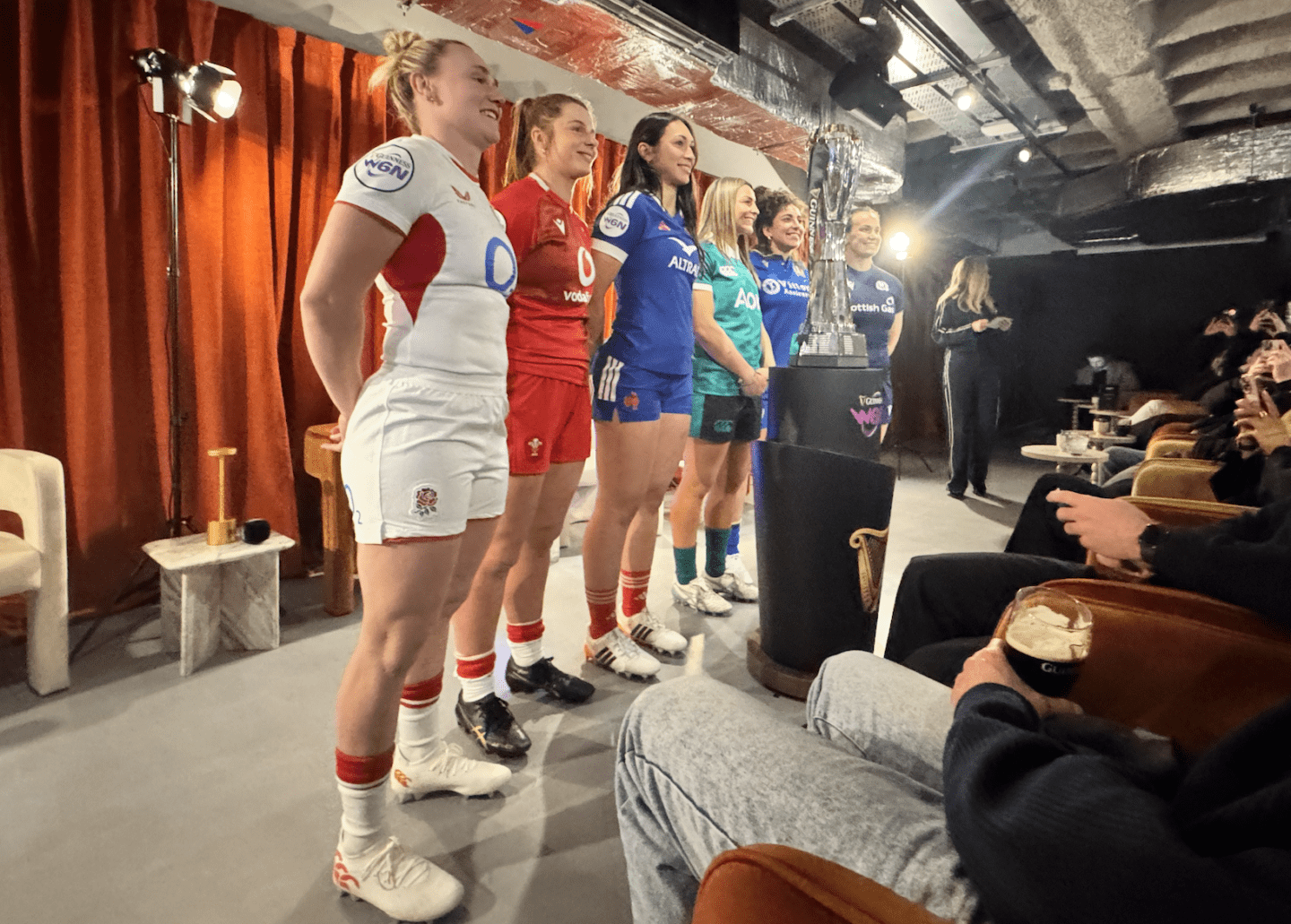
Each of them carries a different story into this Six Nations. Manaé Feleu grew up on the tiny Pacific island of Wallis and Futuna, attended boarding school in New Zealand, and is now captaining France while training to become a surgeon. Erin King is just 22 years old, freshly appointed as Ireland’s captain after fighting her way back from a serious knee injury that kept her out of last year’s World Cup. Kate Williams was born in Swansea, raised in New Zealand, served in the Royal New Zealand Navy, and somehow ended up captaining Wales. Rachael Malcolm holds a PhD in environmental physiology and has been captaining Scotland since 2020 – all while lecturing at university. Silvia Turani, who plays her club rugby at Harlequins and has 47 caps for Italy, was standing in for captain Elisa Giordano.
And then there’s Meg Jones…
Article continues below.


We caught up with England captain Meg Jones in the mixed zone and asked her about being an openly queer role model in women’s rugby – and why visibility matters to her.
“To me, I think my biggest message is just being myself, and that happens to be that I’m a lesbian as well,”
She said. “Being able to voice my relationship and be comfortable with that is probably part of me as Meg. I’m really comfortable in myself, and I find it a bit weird when you have to hide it. We see a lot of straight couples on social media – but why do I have to hide my relationship just as much as the next person?”
Jones – who is in a relationship with fellow England and Great Britain teammate Celia Quansah – spoke about the moments that remind her why openness matters.
“I had a couple of moments after the pitch where a mum came up to me saying about her young daughter and how nice it was – even me just kissing Celia over the barrier. She said that was really nice, because my daughter needed to see that. And it’s funny, because I just never would have thought you’d have to see it, but you really do, because you never know it’s going to be that impactful for you.”
She added: “I think it’s a huge part of who I am, and I think it’s important to keep speaking about it.”
Well said Meg.
Scotland captain Rachael Malcolm spoke about leading her country in this era of women’s sport.
“Captaining my country is a dream come true. It’s a huge honour,” she told us. “But to do it in this era is a big responsibility as well. We want to make the most out of this booming women’s sport era that we’re in. I’m really lucky to lead a group of women who are also passionate about doing everything we can to grow the sport in Scotland.”
Malcolm also touched on the importance of visibility and representation in the game.
“I think it’s up to complete individual preference. Having a bit of privacy is absolutely fine,” she said. “But I think it’s important to have people that you can see who represent what you are. Whether that’s to do with your sexuality, your race, your ethnicity – whatever that is – seeing people like that in the game is super important.”
Ireland captain Erin King – who missed last year’s World Cup through injury and had to watch the growth of women’s rugby from home – summed up what this moment means.
“All the work that was done for that Rugby World Cup and putting women’s rugby on the map, really – I was at home for that World Cup, and I got to see the growth happen, which was amazing to see,” she said. “The stadiums are almost selling out, and it’s so exciting. We grew up watching the lads playing at the Aviva Stadium, and to finally get to play a standalone game there is just so exciting. That’s where we want to be.”
She added: “Women’s rugby in Ireland – there’s still a bit to go, but we’re growing. There’s more and more girls picking up the ball, which is the main aim at the end of the day.”
Record-breaking ticket sales
Last year’s Women’s Rugby World Cup final at Twickenham drew 81,885 fans – a world record for women’s rugby – with 444,465 tickets sold across the tournament. England’s opening match of this year’s Six Nations against Ireland at Allianz Stadium has already surpassed 70,000 tickets sold – a new Women’s Six Nations record. Ireland will play at the Aviva Stadium for the first time in a standalone Women’s Six Nations fixture. Scotland are gunning to break the attendance record for a women’s sporting event north of the border.
England are chasing an eighth consecutive title and are on a world-record winning streak of 33 matches. France, under new head coach Francois Ratier, are rebuilding with serious intent. Ireland, with 22-year-old Erin King at the helm, are on the rise.
The fixtures
The 2026 Guinness Women’s Six Nations kicks off on Saturday 11 April and runs through to Sunday 17 May. Here’s the full schedule:
Round 1 – Saturday 11 April
France v Italy – 12.25pm, Stade des Alpes, Grenoble
England v Ireland – 2.45pm, Allianz Stadium, Twickenham
Wales v Scotland – 4.40pm, Principality Stadium, Cardiff
Round 2 – Saturday 18 April
Scotland v England – 1.30pm, Scottish Gas Murrayfield
Wales v France – 3.35pm, Cardiff Arms Park
Ireland v Italy – 5.40pm, Dexcom Stadium, Galway
Round 3 – Saturday 25 April
England v Wales – 2.15pm, Ashton Gate, Bristol
Italy v Scotland – 4.30pm, Stadio Sergio Lanfranchi, Parma
France v Ireland – 8.10pm, Stade Marcel Michelin, Clermont
Round 4 – Saturday 9 May
Italy v England – 2pm, Stadio Sergio Lanfranchi, Parma
Scotland v France – 4.15pm, Hive Stadium, Edinburgh
Ireland v Wales – 6.30pm, Affidea Stadium, Belfast
Round 5 – Sunday 17 May
Wales v Italy – 12.15pm, Cardiff Arms Park
Ireland v Scotland – 2.30pm, Aviva Stadium, Dublin
France v England – 4.45pm, Matmut Atlantique, Bordeaux
All kick-off times are BST. Every match will be broadcast live and free on BBC, BBC iPlayer and the BBC Sport app.
We’ll be watching,
Nonchalant x
You may also like

This article was written by one of our creative team writers here at Nonchalant Magazine.
