
When was the last time a lesbian couple on screen got to be messy, skint, a bit ridiculous and still end up happy? You & Me Makes Three, the new short from filmmaking duo Emmalie El Fadli and Hansof Waller, does exactly that. It premiered at BFI Flare this year with comedian Jen Brister on board as executive producer, and follows married couple Alannah (Maria Oxley Boardman) and Amara (Dani Moseley) as they try to start a family – first at home with the help of their gay best friend David (Kelvin Ade), then through IUI.
It’s very funny, honest about how expensive and draining fertility treatment can be for queer couples, and firmly on the side of the happy ending. We caught up with Emmalie and Hansof to talk Skins, goggles, non-carrying mums and turning the film into a TV series.
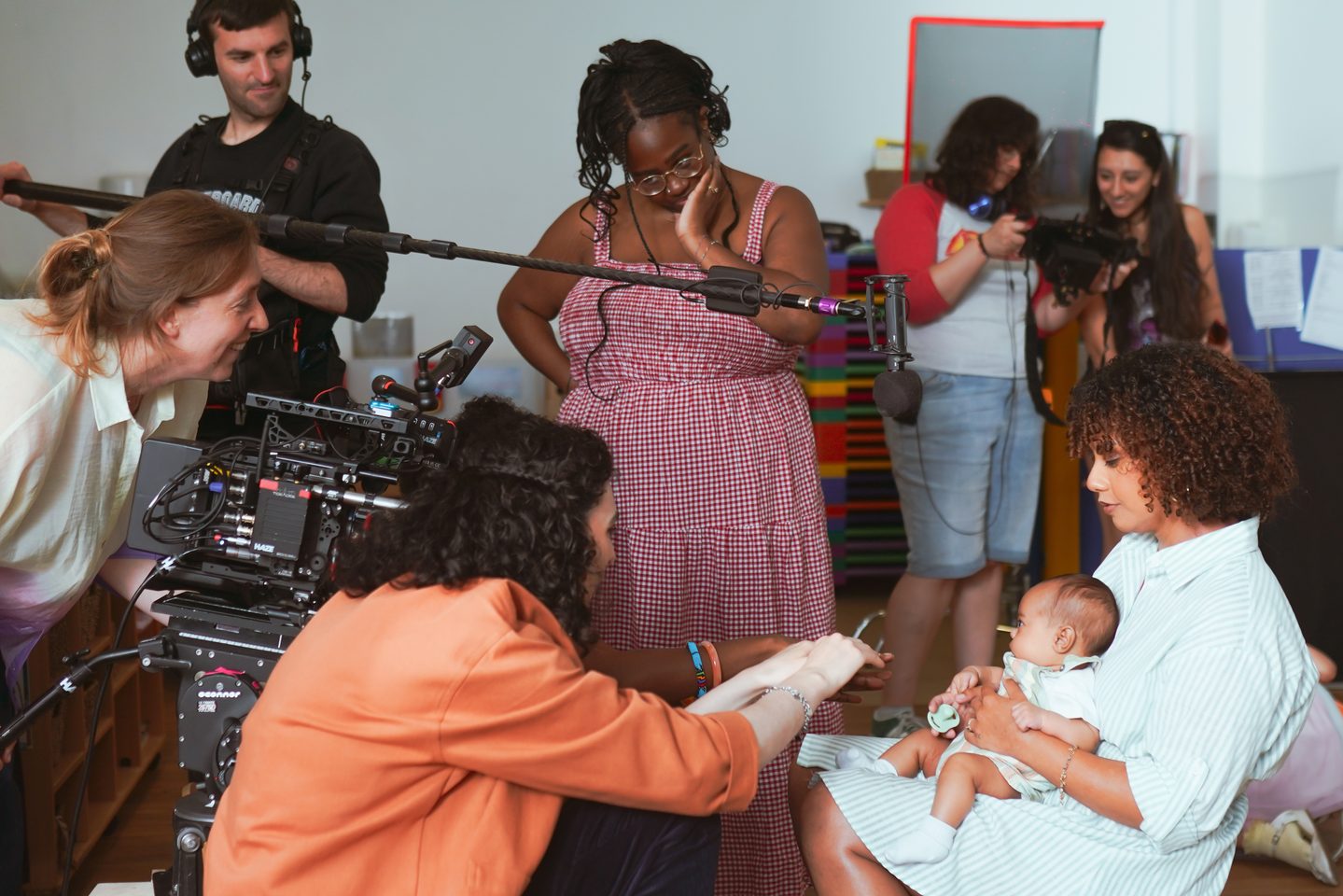
Meet the directors
Emmalie El Fadli is a director and editor who was born in Cambridge and raised across France, Spain and America. She has edited more than 40 short films and three features, and her own shorts have picked up festival awards and over a million views on YouTube. Hansof Waller is a writer, producer and stills photographer who has shot unit stills for the BBC, Netflix and Tubi, and co-wrote the short The Date, which premiered at BFI Flare in 2019 and has racked up nearly two million views on YouTube. The pair met on a short film in 2016, and You & Me Makes Three is their third short together.
Hansof, you’ve spoken about how Naomi’s death in Skins stayed with you. What did you want to do differently with Alannah and Amara?
Hansof: I think Naomi and Emily really affected me because I was a teenager when I watched Skins. They were some of the first sapphic representation I ever saw, and I remember thinking, “Oh wow, maybe I could have something like this one day.” Series four gave them this beautiful ending, so when Skins came back years later, I was so excited to see them still together and happy. Then they decided to end their story with Naomi’s death, which was not needed at all. I was genuinely devastated, and I’m still thinking about it over 15 years later.
Sadly, it’s happened so many times with queer characters, although thankfully things have got a little better. That’s something me and Emmalie really wanted to do differently. With Alannah and Amara, they’re allowed to be messy and complicated and have problems, but ultimately they get to be happy. They get to fall in love, build a family and have a future together. Hopefully someone watching, especially a young queer person, can think, “Maybe I could have that one day too.”
Emmalie, home insemination with strap-ons and goggles is a brilliant set-up. How did you find the comedy in something so many queer couples find stressful?
Emmalie: Can I be honest with you? I just thought it made sense. I don’t take anything in life that seriously and if I went through this journey, this is exactly what I would have done. Even though I’m a lesbian, I was made aware some years back that if you got semen in your eyes, it could cause quite a bit of damage, and who wants to go through that? So the first thing I thought to fix that problem was “swimming goggles!”
Article continues below.
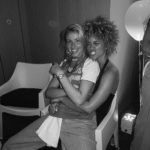
And when it came to the strap-on scene, the idea came to me randomly one night. I mainly had the idea of the contraption itself, thinking, “If this doesn’t already exist, I’m creating it just for our film!” But luckily for us it DID already exist, even though I’d never heard of it before, even when researching for the film. Also, it was extremely important to us that those moments never felt that serious!
The film is honest about the financial and emotional cost of IUI. Why was it important to include that, and what do you hope viewers take away?
Emmalie: Even though we wanted to make a fun film, we still knew we couldn’t shy away from the issues same-sex couples face when it comes to starting a family, and one of the biggest ones is financial. And when it comes to the emotional cost, I felt it was really important to hear from the non-carrying mother.
That part of the film is very personal to Hansof and I because that’s how it is for us; we’d love to have children but don’t want to carry, which does make it a little more difficult when trying for a baby. It cuts your chances in half, and we felt it was important to show the implications this had on the non-carrying mother. The line from Amara, “If I wasn’t such a wuss about giving birth, or having something grow inside of me…” very much comes from my fear of being pregnant. I’m so scared that I’ll either die during childbirth or not be strong enough to carry, I knew I had to get that story in the film somehow.
Hansof: Yeah, and for queer couples it can be really hard and can get really expensive really quickly. As a comedy, we didn’t want it to be all doom and gloom, but you can be really excited about starting a family whilst also thinking, “How the hell are we going to afford this?” I’d just like people to come away understanding that there isn’t one straightforward way to make a family, and hopefully queer people who have been through something similar can recognise bits of themselves in it too.
You’ve been working together since 2016 and this is your third short. How do you split the work between you?
Hansof: It’s never just 50/50 between us. We’ve been working together for so long that we just tend to pick things up as we go. I’m more likely to come up with the completely random and slightly unhinged ideas, and Emmalie is usually the one who’s like, “Okay, but how are we actually gonna make that work?” or “How does that actually fit the story?” Writing-wise, we both come up with ideas, but sometimes one of us will do more of the writing while the other does more of the research, or vice versa. Somehow, after all these years, we still manage to make it work.
Emmalie: Yeah, though because of my dyslexia, I tend to leave ALL the research to Hansof. She’s very good at that. I think if I had to do both the writing and the research, I would have given up a long time ago. That’s why I think we work well together. She does come up with some wacky ideas, but some of them are actually good and stuff I never would have thought of. Also, because she’s a stills photographer, she has a great eye for locations, which helps a lot when location scouting. I would have just gone with the first place we saw and tried to make it work!
How did Dani and Maria come on board, and what did they bring to the characters?
Hansof: Dani and Maria were both brilliant from the start. I’d seen Dani in the hilarious series Dreaming Whilst Black and really loved how good she was at comedy, and there were little moments in the way she played her character in that show that reminded me of Amara. We then worked with the amazing casting agent Emily Chase, who suggested Maria because they’d worked together before. After Emmalie saw her showreel, we both knew she was the perfect Alannah.
Emmalie: Yeah, even though Maria’s showreel was a bit more on the drama side, there was just something in her mannerisms that I thought was perfect for our character Alannah. And when we did jump on a Zoom audition, she knocked it out the park.
Hansof: They’d never actually met before we put them together on a Zoom, but the chemistry was pretty instant. We were really lucky with them because we needed them to feel like a real couple, not just two actors saying the lines we’d written, and they both understood the characters straight away.
Dani brought so much to Amara. She has that really funny energy, but she also brought loads of warmth and vulnerability to her. There are quite a few little things about Amara that were really important to us, and Dani just got it. And Maria brought a really natural warmth to Alannah. She has this really grounded, thoughtful quality, but she’s also really witty, and Maria brought all of that out really naturally. She just really understood who Alannah was. So when you put them together, it just worked. You really believe they love each other, and that was a very important thing to us.
What’s next for you both, and for the film?
Hansof: For the film, we’re still getting it out into the world and seeing where it takes us. We’ve had some really lovely festival acceptances so far, including BFI Flare, Women X and Out On Film, and it’s been amazing seeing people respond to it, especially people who have been through similar journeys to our characters. So we’re just trying to keep that going and get it in front of as many people as we can.
We’re also trying to develop You & Me Makes Three as a TV series, which is a really exciting next step for us. We’re currently writing the pilot, and honestly, that’s something we never would have thought was possible when we first started making these shorts. It’s a massive thing for us, but we always just want to keep making more positive sapphic stories, so getting to continue Alannah and Amara’s story would be so fantastic.
Emmalie: Yeah, there’s so much story left to tell! And if the TV series doesn’t work out, we’ll definitely turn it back into a feature film. For me as an editor though, I’m constantly working, so I have lots of OTHER people’s work in the pipeline. As for writing, I have a few scripts I’d like to go back over and hopefully get another film made pretty soon. As for the film itself, after the festivals we’re hoping to find a wonderful place for it to sit, so more people can watch it.
Where can I watch You & Me Makes Three?
The film is still on its festival run. After BFI Flare, Women X and Out On Film, it has just screened at Love and Hope Film Festival in Barcelona, Sunday Shorts and Way Out West. Coming up, you can catch it at Queerhub on 24 October 2026 and Women of the Lens on 27 November 2026. A wider release is planned for next year, though no details are set yet – follow @youandmemakesthreefilm on Instagram for upcoming screenings.
Nonchalant x
Your next read: The best lesbian short films
You may also like
This article was written by one of our creative team writers here at Nonchalant Magazine.

