
London-based alt-pop artist Phoebe Hall has just released ‘Lighter’, the final single in a trio this year following ‘Everything Has Changed’ and ‘Boyfriend’. It’s a big, guitar-led pop song about the moment you decide to stop being sad and start feeling good again, and it’s made to be yelled in the car.
We caught up with Phoebe about hopecore, coming out as nonbinary, their queer role models and where they go for a night out in London.
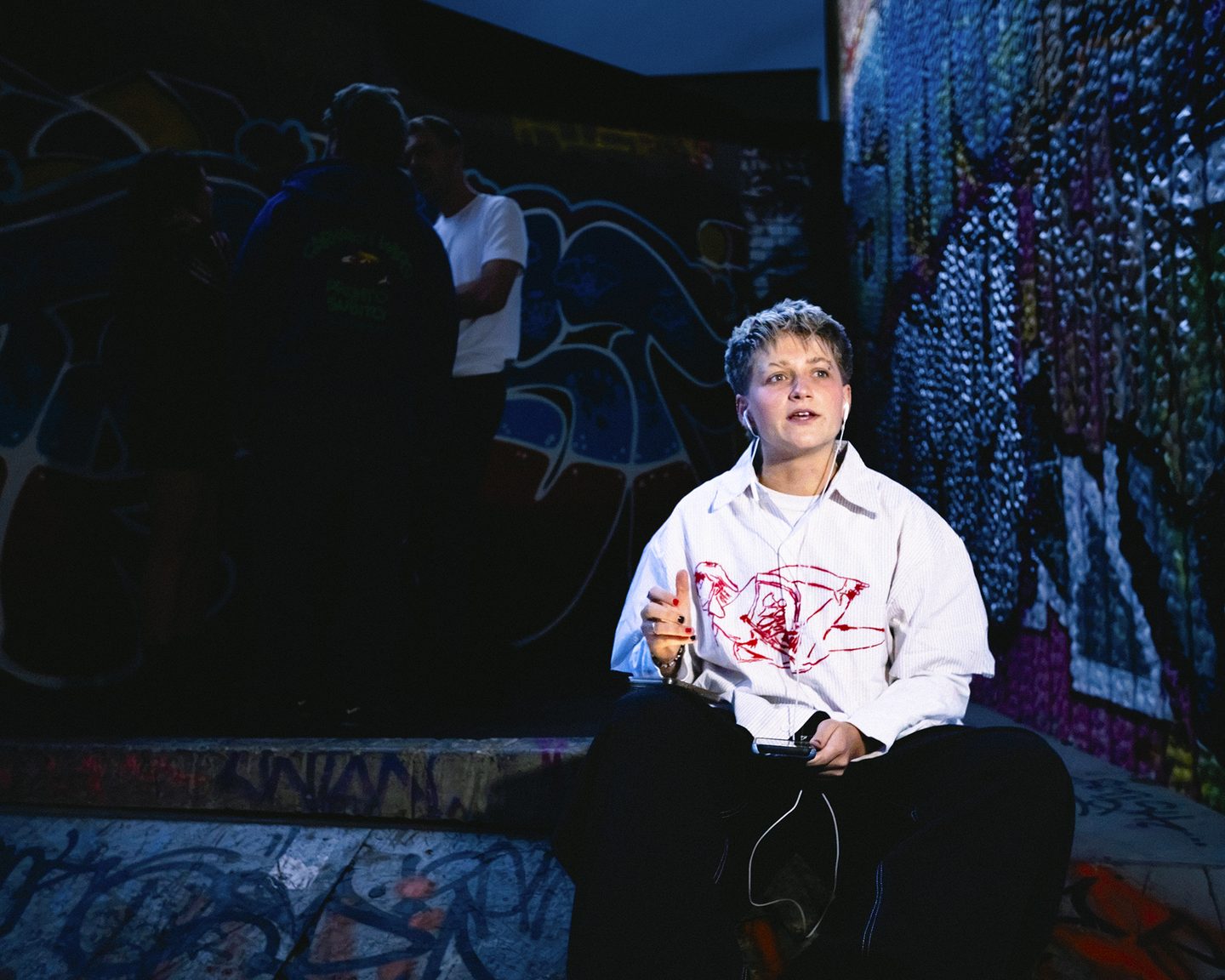
You’ve called ‘Lighter’ a real “fuck it” song. What inspired this?
I really wanted ‘Lighter’ to be about a specific moment, to capture a shift when you’re getting over something. I think you can get almost scared of moving on, but this is the realisation that you want to move on, you want to put yourself first, even if that jeopardises any healing or self-work you’ve been doing. I think that is the “fuck it” element.
You’ve described it as “hopecore”. What does hopecore mean to you, and what does it sound like?
I think hopecore is about being uplifting without being unrealistic or washing over the harder bits of life. It’s all about community, and hope being encouraged by the people around you. That’s why I think ‘Lighter’ fits, as it’s a back and forth between confidence and uncertainty. Sonically, it has a playful palette, but there’s a lot more grit and guitars than some of my other work, so I think you get this sense of a process taking place.
You’ve gone from York to Edinburgh and now London. What did each city give you, and where in London feels most like home so far?
York is home, so it’s where a lot of my musical roots are, where I first started to write and where I first decided I wanted to do this.
Article continues below.




Edinburgh is where it all started to become real for me. I met so many people I still work with today, started doing more performance work and began writing more and more. It was also when I signed my first record deal, and music started to feel more like a career.
You may also like: Lesbian singers: Our legend list
London feels like where everything is coming together. My friends and community are here, I’m making some of my favourite music, and I’m getting to work on bigger projects. I live in North London and it really does feel like home. All my closest mates are nearby, and sometimes it honestly feels like we’re living in a TV show.
You started out making bedroom pop and you’re now making big, anthemic pop. What gave you the confidence to go bigger?
I think performing. I always thought my range was only low, but performing has pushed me to run about, belt and try new stuff vocally, and that’s meant the songs have grown.
‘Lighter’ is made for yelling in the car. What song do you scream along to when you need to switch your mood?
Anyone who knows me knows how much I love Justin Bieber and One Direction. These will literally never fail to get me out of a bad mood.
You’ve said you want to make pop music for queer people. What did you wish you’d had growing up that you’re trying to make now?
I think gender fluidity is still underrepresented in pop. I want to make music that everyone listens to, but that talks about queer people and experiences. I love seeing artists like Chappell Roan do that, and I want to be part of it too. Growing up, seeing gender fluidity as something completely normal, rather than something alternative or outside the mainstream, would have meant so much to me. Representation really is everything.
You write very openly about your identity and queerness. Has that honesty ever felt scary, and what has the response from queer fans been like?
Putting the music out can feel quite scary, especially because I find it really hard to write about anything that isn’t directly from my own experience. Figuring out how to market and talk about something that feels so deeply personal can be daunting for sure. I also think the music often tells me how I feel before I even know myself, which can be super confronting. Scary as that can feel, I wouldn’t change it, as I think it’s just how I naturally make music.
Who were your queer role models growing up, and who made you feel like a career in music was possible for you?
Troye Sivan is a big one for me. I watched him on YouTube as a kid, and it’s been so cool watching his journey and seeing him express his queerness more and more. He definitely made a career in music feel possible for me. Mae Martin’s ‘Feel Good’ also really helped me work out a lot about myself, and inspired ‘Like This’ in particular. Meeting the people I work with now has helped me feel fully comfortable being myself in my music too. And a huge shoutout to Hayley Kiyoko and the ‘Girls Like Girls’ music video – that was massive for me growing up.
Which queer artists are you listening to right now, and who should our readers have on their radar?
Underscores, MUNA, Troye Sivan, Kae Tempest, Ryan Beatty, and one of my best friends, Crybby.
Songs like ‘Through the Phone’ and ‘Like This’ explored androgyny and finding comfort in your own skin. How has your relationship with your style and appearance changed since then?
I feel in such a different place with this. I still have dysphoria, but I feel so much more myself now, like I’ve worked out who I am more. I’ve come out as nonbinary since the release of both of those songs, and I can almost hear myself working that out in the music. I feel much more comfy in androgyny, I know my style more, and I get excited to explore it more and more as I get older.
The new track has a real 90s pop feel. If ‘Lighter’ were a 90s outfit, what would it be wearing?
If we’re going with the “fuck it” sentiment, maybe a 90s grunge or Britpop outfit? Messy hair and baggy jeans.
You wrote this with your long-time collaborator Danny, who was there throughout everything. What makes a good creative partner, and do you think chosen family shows up in your work?
Totally. I think community is everything in music, particularly with the industry like it is at the minute. More and more people are becoming independent, and working with the people who know you best and inspire you so much is integral.
Where’s your perfect queer night out in London?
At the minute it’s the Aqua pop night at Dalston Superstore.
What’s the most memorable moment you’ve had on stage so far?
There’s a lot. At the minute it’s a fundraiser gig I did in the summer called Tops Off. We raised a lot of money for gender-affirming care, and I got all my mates to do cameos in the set and sing with me. That’s my favourite thing.
Lastly, where can people see you perform next?
I’m waiting on the rescheduling of my show with Sapphic Sounds, so hopefully soon. Performing is my favourite thing though, so book me!
‘Lighter’ by Phoebe Hall is out now on all streaming platforms. Follow Phoebe on Instagram at @ph0ebe_hall.
Nonchalant x
Your next read: Meet FOX GUNN: The London-Based Artist Making Queer Pop Sexy
You may also like

This article was written by one of our creative team writers here at Nonchalant Magazine.

